
Use your data.
AI for payment exceptions and investigations (E&I)
- Investigate payment exceptions across messages, lifecycles and counterparties.
- Evidence you can follow, and resolutions a person approves.
See it in action Discuss an evaluation
The problem
A payment exception is rarely answered by a single message. Resolving one means reconstructing what happened across related messages, the payment's lifecycle and the counterparties involved, then defending the conclusion to an auditor or a correspondent. That is slow and manual, and an answer from a general-purpose assistant that cannot show its evidence is not usable in an investigation.
Swift puts the scale of this across the industry at more than USD 1.6 billion each year, spent on labour-intensive processes to investigate payments that get held up.
See TxAgent investigate
Two investigations, start to proposed resolution.
These recorded demonstrations show TxAgent investigating payment exceptions from initial inquiry to proposed resolution. TxAgent can be integrated into existing applications and workflows through APIs and MCP, or accessed through AI assistants such as Claude Desktop, as shown here.
The cover payment is missing
-
The inquiry. A
camt.110arrives reporting that a cover payment was never received, and is classified as cover non-receipt. -
The evidence. The customer transfer is reconstructed from the related
messages, and the expected
pacs.009cover is found to be absent. -
The check before the fix.
camt.054nostro activity is inspected first, because the risk in correcting a missing cover is sending a second one. -
The proposal. A corrective
pacs.009and acamt.111response are drafted, with the evidence attached, for a person to review.
The beneficiary address is unusable
-
The inquiry. A
camt.110is linked back to thepacs.008payment it concerns. - The evidence. The chain is retrieved and read, and the exception is traced to an unstructured beneficiary address rather than to a routing or funding fault.
-
The proposal. A
camt.111response and a correctedpacs.008are drafted for review. - The record. The sources, the actions taken and the reasoning stay with the case.
How an investigation runs
From an inquiry to evidence-backed next steps.
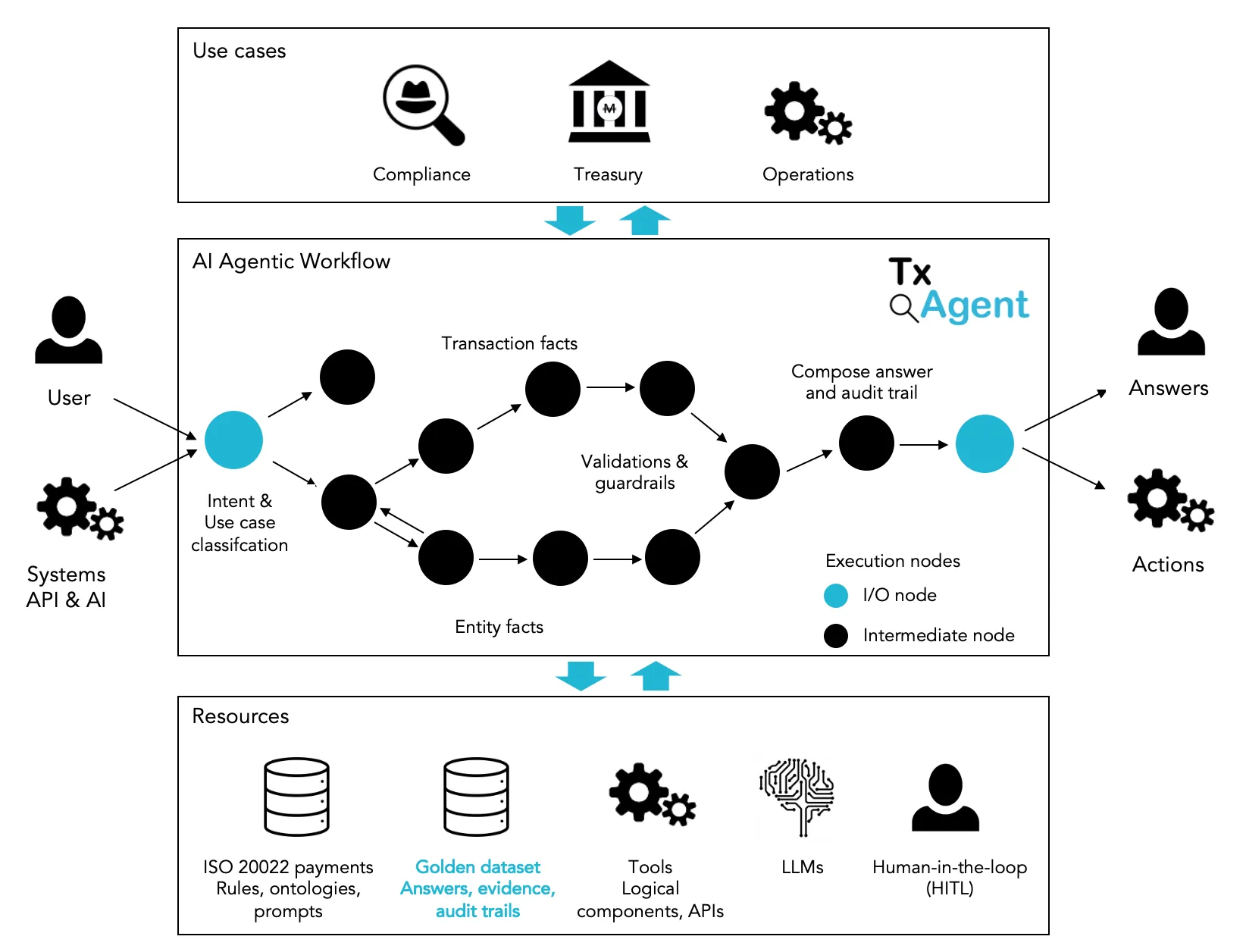
ISO 20022 provides the transaction data. Case orchestration manages the workflow. TxAgent adds the investigation and reasoning layer, connecting payment messages, reconstructing lifecycles, gathering evidence and preparing resolutions for human review.
- Understand Interpret the inquiry against ISO 20022 semantics, and set the scope of the case.
- Investigate Find the messages, parties and relationships that bear on the question, retrieved progressively rather than all at once.
- Validate Check the findings against the records and the constraints, including what is missing.
- Recommend Return an evidence-backed answer, the log of what was done, and the next steps, including the ISO 20022 messages drafted to remediate and close the case.
Human review and decision. The proposal goes to a person. TxAgent supports the next step; it does not take it.
TxAgent dynamically adapts its investigation to the question, the available evidence and the findings uncovered along the way, rather than following a fixed sequence of steps.
Explore the architecture
TxAgent orchestrates language models, structured payment data, tools and validation steps through a dynamic investigation workflow. The paths depend on the question and the evidence available.
Trust and control
A conclusion an investigator cannot defend is not an answer.
What comes back with every answer
Each run returns the answer, the reasoning that produced it, the log of actions taken on the way, and a run identifier that ties the whole thing together. Where a case calls for them, the answer carries the corrective messages drafted to remediate or close it. Evidence is part of the output rather than an appendix to it, because a finding has to survive an auditor, a regulator or a correspondent asking where it came from.
Scoped retrieval, not bulk context
A question is planned into a search over the relationships in the data, so only what the question needs is retrieved, rather than a dataset being pushed through a model's context window.
TxAgent dynamically constructs complex queries across the rich semantics of ISO 20022, navigating payment messages, entities and relationships to retrieve precisely the evidence needed for each investigation.
Across ISO 20022 messages
TxAgent is not limited to a predefined set of payment messages.
TxAgent understands the structure and semantics of ISO 20022 and can dynamically explore messages, fields and relationships relevant to an investigation.
Which messages are covered
Dedicated investigation capabilities support common payment exceptions, including inquiries
and responses (camt.110, camt.111), recalls
(camt.056, camt.029), customer and cover payments
(pacs.008, pacs.009), and account notifications
(camt.054).
Beyond these established investigation paths, TxAgent can navigate other ISO 20022 message types to retrieve relevant information and uncover relationships across the payment lifecycle.
Tested systematically
Reliable AI requires systematic testing, not just convincing demonstrations.
TxAgent undergoes continuous regression testing against reference investigation scenarios, checking factual accuracy, supporting evidence and operational behaviour.
Automated testing helps identify regressions as models, prompts and retrieval capabilities evolve, supporting consistent and reliable investigations.
Validation methodology and results
What is validated
Each investigation scenario defines the expected findings, supporting evidence and evaluation criteria. Tests assess:
- Retrieval and context. Identification of relevant payments, messages, parties and relationships.
- Evidence quality. Conclusions supported by the correct records, with uncertainty made explicit.
- Investigation behaviour. Handling of missing information, conflicting evidence and investigation boundaries.
- Operational reliability. End-to-end execution, errors, latency and stability under parallel load.
How the tests run
Reference investigations are maintained in a reusable test dataset. Validation combines conventional assertions with semantic checks to evaluate the substance of an answer, even when its wording varies.
Complete investigations are executed in parallel using Exense Step, with centralised logs and execution traces supporting debugging and regression analysis.
Published testing results
In published testing with 100 investigation scenarios, parallel execution reduced total test-suite runtime by approximately 50% compared with the fastest local configuration, achieving around 24 completed tests per minute.
These figures describe testing performance, not investigation accuracy or production throughput.
Further reading: TxAgent testing methodology and the Exense technical study.
Investigate through the tools you already use
Open interfaces rather than another console: APIs, MCP and AI assistants, reading your ISO 20022 messages directly.
TxAgent can be accessed through supported APIs, MCP-compatible applications and AI assistants such as Claude Desktop, as shown in our demonstrations.
Where a case management system is already in place, TxAgent can integrate with it through its API. That integration is built for the deployment rather than shipped as a prebuilt connector.
Investigators can ask questions in natural language, retrieve supporting evidence and prepare resolutions without adopting a separate investigation platform.
Where it runs
TxAgent is designed for deployment in your own infrastructure, keeping the payment database under your control.
AI reasoning currently uses an external language model service. Provider selection, data handling and security requirements are addressed during deployment.
What it needs from your data
TxAgent ingests your ISO 20022 messages and builds a connected view of transactions, parties and payment lifecycles, enriched with public BIC reference data.
The ingestion pipeline and financial messaging data model are provided with the product, using Neo4j as the underlying graph database. No prior knowledge graph or custom ontology project is required.
An evaluation can start with a representative extract of payment messages, without connecting your entire banking infrastructure.
Human oversight remains central. TxAgent prepares evidence-backed findings and, where applicable, schema-valid corrective messages. It does not send messages and does not execute resolutions: approval, transmission and operational decisions remain under the bank's control.
Beyond exceptions and investigations
TxAgent's ability to explore financial messaging data also supports broader analytical and investigative applications.
- Compliance and AML. Investigating payment flows, parties and relationships.
- Treasury. Exploring intraday cash movements and account activity.
- Front office. Analysing customer and counterparty payment activity.
These applications are illustrated in recorded demonstrations, while payment exceptions and investigations remain TxAgent's primary commercial focus.
Explore our demonstrations and applications.
Evaluate TxAgent on your own cases
Bring a representative payment exception from your own traffic.
Evaluate TxAgent on cases with known outcomes, assessing investigation accuracy, supporting evidence, proposed resolutions, integration requirements and operational controls.