
Fix your data.
ISO 20022 address structuring
- From free-text addresses to hybrid or structured ISO 20022.
- Automate with accuracy, control and traceability.
See it in action Discuss an evaluation
The problem
Payment messages often contain postal addresses as loosely formatted free text. Inconsistent names, streets, cities and countries complicate automation and create manual remediation work.
Swift postponed the deadline for removing unstructured postal addresses from CBPR+ payment messages due to industry readiness concerns. As of October 2026, no replacement date has been confirmed.
The scale is unchanged by the postponement: around 60% of debtor postal addresses in CBPR+ payments were still unstructured in mid-2026, on Swift's own published figures.
The deadline has moved. The underlying data problem remains.
TxFlow helps financial institutions address it now, independently of regulatory timelines.
From unstructured to structured
See how ISO 20022 address conversion works in practice: free-text postal addresses become structured elements, source information is preserved, and cases needing review are identified rather than guessed. The record below is a real one, with the values and the decisions its runs actually produced.
Input, as it arrives

<PstlAdr>
  <AdrLine>San Elijo Dance & Music Academy,
  <AdrLine>1635 S Rancho Santa Fe Rd, 92078,
  <AdrLine>San Marcos, CA, US
</PstlAdr>Town and country placed. The rest stays on the address line.

<PstlAdr>
  <TwnNm>San Marcos
  <Ctry>US
  <AdrLine>San Elijo Dance & Music Academy,
  <AdrLine>1635 S Rancho Santa Fe Rd, 92078, CA
</PstlAdr>
In the Workbench this record is marked passed: it ships without requiring a review.
Every element the source supports, placed. No address line left.
<PstlAdr>
  <StrtNm>S Rancho Santa Fe Rd
  <BldgNb>1635
  <BldgNm>San Elijo Dance & Music Academy
  <PstCd>92078
  <TwnNm>San Marcos
  <CtrySubDvsn>CA
  <Ctry>US
</PstlAdr>
Also passed. A record is only as good as its weakest element, so the fuller output is the harder one to clear.
Full fidelity. Nothing is invented, and nothing is quietly dropped. Each format carries what it can: placed into an element, or left on the address line. When a component cannot be placed at all, the record is blocked rather than shipped short.
Can it enrich incomplete addresses?
Yes. Structuring an address is not the same as enriching it.
Full-fidelity conversion reorganises information supported by the original source. It does not invent missing address components to produce an apparently complete result.
Enrichment introduces information derived from additional reference data or context. It is a separate, explicitly enabled operation.
This distinction matters in payment operations: a plausible-looking address is not necessarily a correct one. TxFlow keeps the provenance of the information, and the decision to enrich it, explicit.
Concretely, in the product as it ships:
- On by default: country resolution. A country derived from the rest of the address is the one enrichment most deployments want, and it is the one the evaluation measures.
- On request: inferred-value enrichment and geolocation. Both are available on demand. Neither arrives switched on.
Where a value cannot be supported by the source and enrichment is not enabled, the field is left empty and flagged. It is never filled with a guess.
TxFlow Workbench
Address remediation with control and traceability.
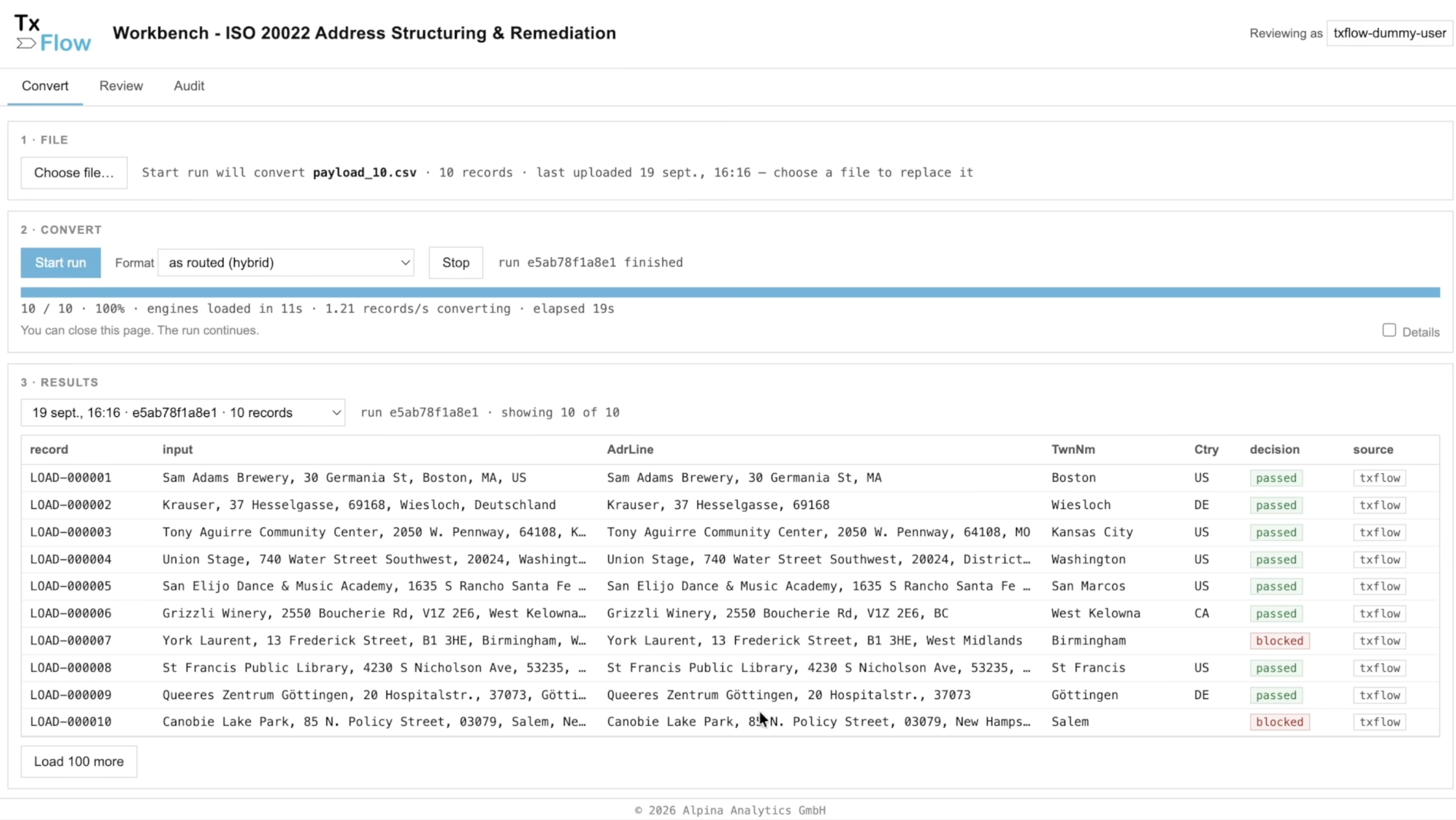
TxFlow does the remediation. Workbench is the user station it is operated from: a place to run a conversion, review what it could not decide automatically, and read back what happened to every record. The process runs in three steps: Convert, Review and Audit.
Convert
A run in progress, and a decision recorded against every record.
Import Excel, CSV or ISO 20022 data. Process addresses into hybrid or fully structured formats, with configurable output routing. Additional cleaning is available on demand.
Review
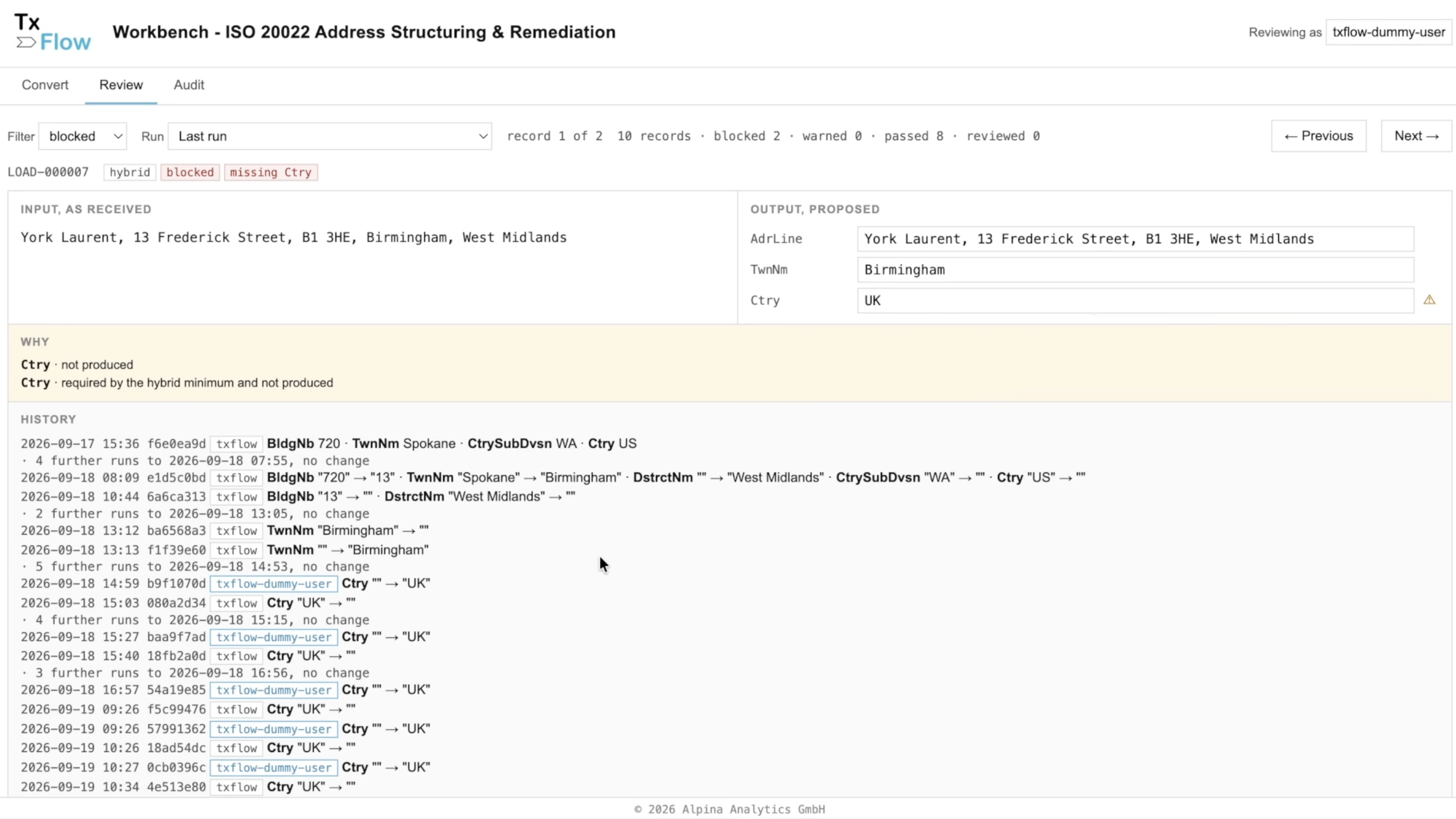
A held record, with the rule that held it and the value it is missing.
Inspect uncertain results, missing fields and confidence assessments. Reviewers can correct or approve results before export.
What reaches a reviewer is decided by three processing states.
- passed The extracted value meets the configured confidence threshold and is applied.
- warned The value is applied but flagged for review, so potentially weaker evidence stays visible.
- blocked The record is held because a required element cannot be safely delivered without intervention.
Acceptance thresholds are configurable. Financial institutions decide how much supporting evidence is required before a value can be processed unattended.
Audit
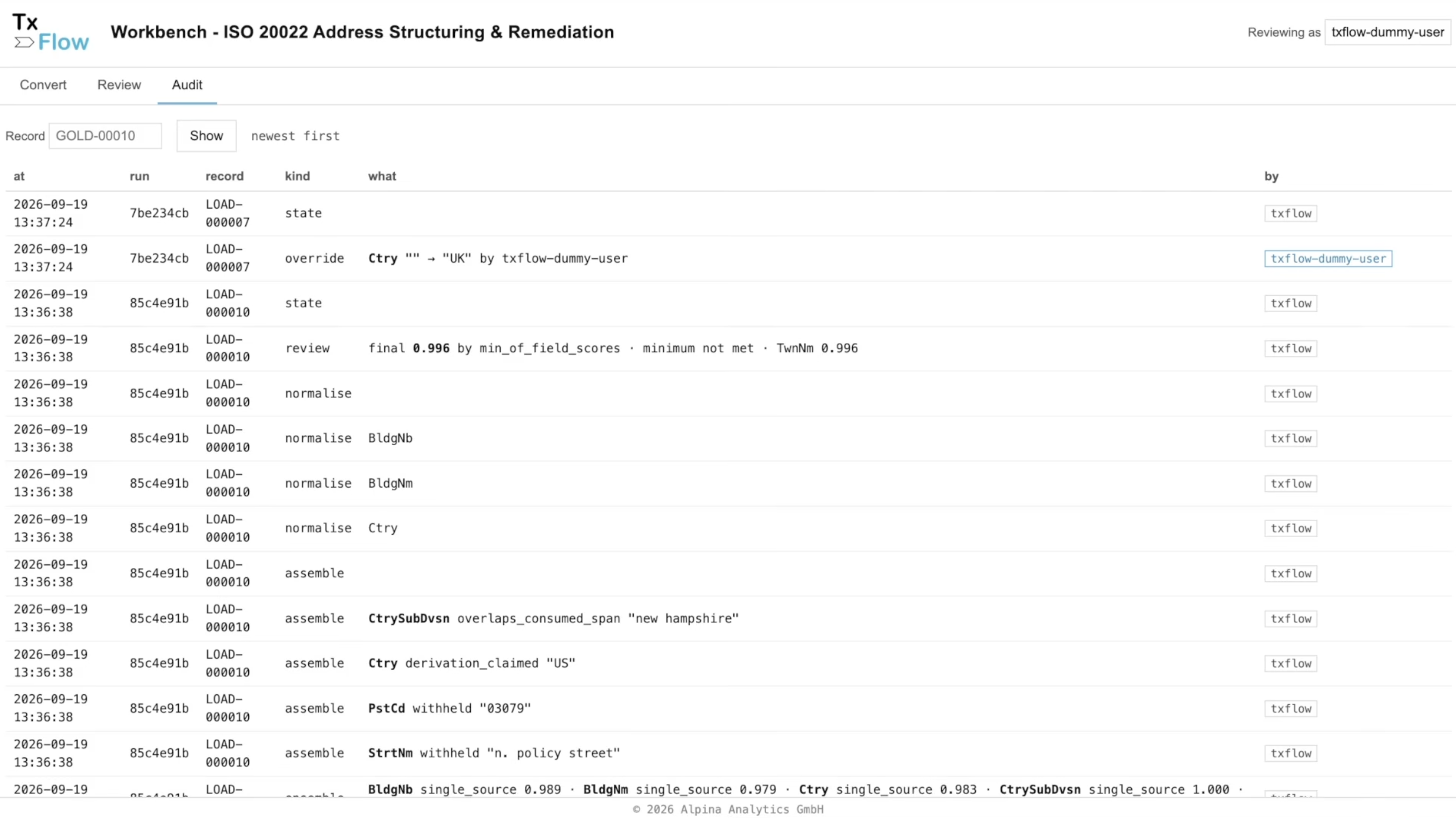
Every change to a record, scored, timed and attributed.
Trace the complete processing history of each record: extracted values, transformations, confidence assessments and reviewer decisions. Every recorded event identifies what changed, when it changed, and whether the action was performed by the software or a reviewer.
The result is a remediation workflow that combines automation with explicit control over uncertain cases.
Accurate extraction, controlled decisions
Measured confidence. Thresholds you set.
TxFlow assigns a measured confidence to each field it produces, and applies your thresholds to decide what is applied automatically, what is flagged, and what is held for a person.
- Configurable thresholds. Balance automatic processing against the confidence requirements of each workflow.
- Traceable decisions. Record the evidence and the processing decisions behind the output.
- No LLM in the critical path. Extraction runs on local machine-learning models, in your environment. No generative model decides what an address element is, and nothing is sent to a hosted service to find out.
A field's confidence is measured, not estimated per address: it is that field's accuracy on an evaluation corpus, and it travels with every value the field places. A record takes the confidence of its weakest field, so placing more elements can only lower it.
Tested and measured
TxFlow draws on extensive geographic and address reference data, with worldwide coverage and resources at billion-record scale.
The extraction pipeline has been evaluated on thousands of publicly sourced, payment-relevant address samples, including deliberately introduced noise and formatting inconsistencies.
Validation methodology and results
We measure extraction accuracy and the ability to identify uncertain results. Our objective is to maximise reliable automation while keeping the risk of incorrect or unsupported data under control.
Evaluation data
Our evaluation uses two complementary layers:
- Worldwide reference data. Billions of open-data records support geographic and postal resolution across countries.
- Address extraction tests. Thousands of public reference addresses, including deliberately degraded and inconsistently formatted inputs, are used to evaluate extraction performance under conditions resembling real-world remediation.
Measured accuracy by field
The following results were obtained on an initially unseen evaluation corpus, before its subsequent use in development.
| Address field | Measured accuracy |
|---|---|
| Country | 100% |
| Country subdivision | 100% |
| Town | 99.1% |
| Building number | 98.3% |
| Postal code | 96.3% |
Why accuracy is not 100%
Real-world addresses are often incomplete, inconsistent or ambiguous. Postal codes can be mistaken for building numbers, and place names may have multiple interpretations.
TxFlow manages this uncertainty through automated validation, configurable confidence thresholds and human review, helping prevent unreliable results from entering downstream processes.
Configurable confidence thresholds
TxFlow applies field-specific confidence thresholds, allowing banks to balance automation coverage with the reliability of accepted results.
Results that do not meet the configured thresholds are flagged for review. Decisions and their supporting evidence remain traceable through the field-level audit trail.
Scope and limitations
Results reflect internal testing on public reference data, not customer production or independent benchmarking. Actual performance depends on input quality, geography and configuration.
Calibration on the customer's own data ultimately establishes achievable accuracy, automation coverage and appropriate confidence thresholds.
See TxFlow Workbench in action
Beyond address remediation
TxFlow is more than an address conversion tool.
Beyond Workbench, TxFlow supports broader financial messaging processing, transformation and enrichment.
Financial messaging parsing and transformation
Parse ISO 20022, SWIFT MT and ISO 15022 messages into structured, machine-readable data, preserving message hierarchy, field types and business context.
Support downstream applications, analytics and integration through nested or tabular outputs.
Data enrichment and normalisation
Improve financial messaging data through configurable geographic, postal and business-data normalisation and enrichment.
Source-faithful transformation and inferred enrichment remain clearly separated, giving banks control over how their data is processed.
Better data, broader applications
Structured financial messaging data provides a foundation for more effective sanctions screening, payment investigations, customer intelligence and operational analytics.
Explore our applications or the technical documentation.
Deployment and integration
Run TxFlow in your environment.
TxFlow integrates with existing banking infrastructure, whether in the cloud or on customer-managed systems.
- On-premises. Customer-managed infrastructure, including air-gapped deployment options for Workbench.
- Cloud, in your own environment. Google Cloud or compatible infrastructure, deployed within your own tenancy.
- Flexible deployment. Docker and Kubernetes for supported components, or a single virtual machine where simpler.
- REST APIs. Integrate batch and automated processing into existing workflows without requiring the Workbench interface. See our demonstrations.
- Scalability. Stateless processing services that can be replicated to meet workload and throughput requirements.
- Data stays under your control. Address data is processed within your environment, with no transmission to Alpina Analytics.
Deployment options depend on the selected components and your infrastructure. See our deployment and integration documentation.
Licensing
TxFlow offers flexible licensing options depending on deployment and processing volumes.
- On-premises. Enterprise licensing tailored to your environment.
- Cloud. Usage-based licensing on Google Cloud, or enterprise licensing on other cloud infrastructure.
Evaluate TxFlow on your data
Find out how TxFlow performs on your address data.
Evaluate extraction accuracy, conversion completeness, automation coverage and traceability using a representative sample of your data.
Provide a CSV extract of addresses and receive the converted output, confidence scores, processing decisions and a field-level audit trail.