TxFlow - ISO 20022 Data Intelligence Layer
Update, 14 October 2026. Swift deferred this deadline on 27 August 2026 on industry readiness grounds, and no replacement date has been confirmed. The dates below are left as written because this is a dated post; they no longer describe the position. See ISO 20022 address structuring and remediation for the current wording.
Correction, 15 October 2026. Two claims have been removed from the list below rather than left standing with a note, because neither was true of the product when it was written. “Proven in Tier-1 banking environments” read as a deployment; TxFlow has never run in one. The Tier-1 experience is the founder’s own, from seven years at Credit Suisse, and it is set out as what it is on services. “Production-grade” was a readiness promise with nothing behind it. What the software does measure is published, with its method, on the product page.
The ones planning ahead already know it.
Starting on 22 November 2025, institutions will have one year, until 14 November 2026, to remove unstructured postal addresses from ISO 20022 messages.
From that point, hybrid addressing becomes the new default, paving the way for a fully structured format soon after.
It’s more than compliance.
Structured data means higher STP, better analytics, and a foundation for AI-driven workflows.
TxFlow makes you ready:
✅ Convert unstructured to hybrid, structured, or geolocated formats
✅ Enrich critical fields inside (e.g. country code) and outside addresses
✅ Deploy as a scalable, on-prems Kubernetes cluster
✅ Supported by experts in AI, data and system engineering
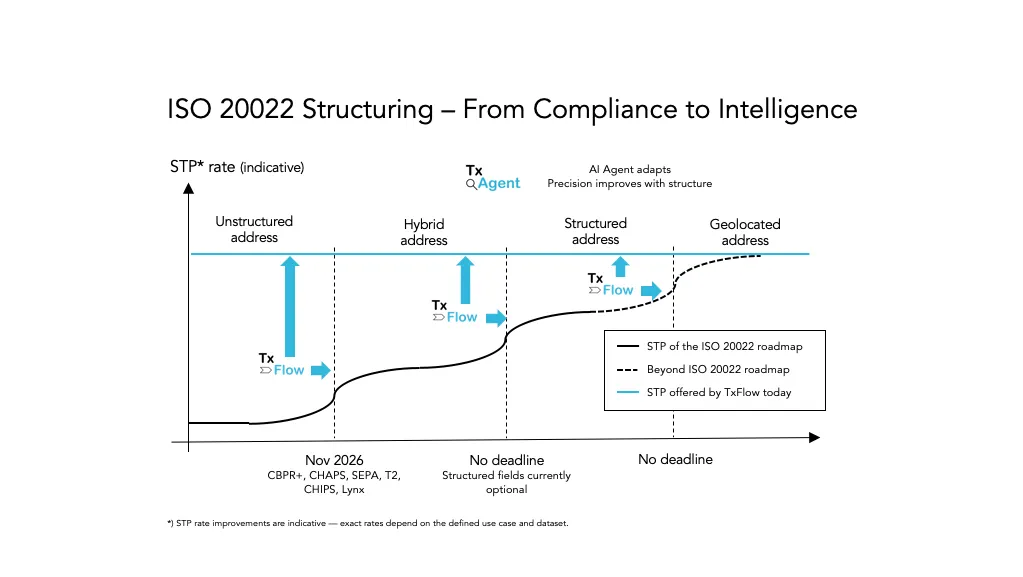
It’s time to go beyond compliance and build the data intelligence layer ISO 20022 brings on a red carpet.
🎥 More demonstrations: see them all
From Compliance to Intelligence.